Data breaches can impact your entire business
When Facebook founder and CEO Mark Zuckerberg testified before the House Energy and Commerce and Senate Commerce committees about missteps related to his company’s infamous cybersecurity breach, one member of Congress noticed the social media founder’s failure to acknowledge the potential negative impact the breach could have on small businesses.
Since U.S. Rep. Nydia M. Velázquez, D-N.Y., isn’t a member of one of the committees that questioned Zuckerberg, she expressed her concern in a letter that read: “If small firms’ customer data was compromised, those companies’ brands—through no fault of their own—may be permanently damaged. Facebook must be held accountable to the Main Street small businesses who trusted them,” ACA International Vice President of Communications Kim Coghill reports in the August issue of Collector magazine.
A quick recap of the Facebook breach: Cambridge Analytica used an app to illegitimately access the personal information of approximately 87 million Facebook users, including 71 million Americans. Zuckerberg was called to Washington to testify in reference to the incident and about the social media giant’s policies and procedures around data security.
Velázquez noted in her letter that most small businesses do not have the staff or financial resources to become experts in cybersecurity, nor do they have the ability to identify whether their customers were impacted by the Facebook breach. So, as the ranking member of the House Committee on Small Business, she asked Zuckerberg to provide insight as to what Facebook is doing to educate small businesses about the breach and what type of analysis has—or will—be conducted on the social media giant’s policies and systems to ensure this type of incident doesn’t occur in the future.
While Velázquez’s questions have yet to be fully answered, one important lesson we can take away from the Facebook debacle is to carefully read privacy policies and terms of use before clicking “agree” when signing onto any app, social media channel or website. This is especially true for small businesses trying to compete in a fast-paced world that relies heavily on social media and other high-tech internet applications.
The Weak Link
Data security, or the lack of it, can be extremely expensive, according to Verizon’s 2018 Data Breach Investigations Report.
And just as important, data breaches aren’t just a problem for security professionals.
The report noted: “The impact is felt across the whole business—from your legal team, embroiled in litigation, to your front line employees, who can’t access the tools they need to do their jobs. Everyone needs to play their part in managing the risks.”
The Verizon report, based on the analysis of more than 53,000 real-world incidents, revealed what you probably already suspect: 76 percent of data breaches were financially motivated and almost 73 percent of cyberattacks occurred at the hands of outsiders. This means that about 28 percent of these breaches didn’t involve unknown hackers, but rather company insiders.
Before you start looking over your staff’s shoulders, remember that “malicious employees looking to line their pockets aren’t the only insider threats you face,” according to Verizon.
Oftentimes, the problem is the result of innocent errors, totaling about 17 percent of the breaches in Verizon’s study. Missteps can include failing to shred confidential information, sending an email to the wrong person, losing a laptop or misconfiguring web servers, Coghill reports.
Additionally, not all employees feel empowered to report data privacy and security incidents.
Back in Washington, leaders continue to debate legislative proposals to help resolve issues that plague American consumers when they make purchases, use mobile payment technologies or log on their computers at home or at work.
ACA International will continue to engage with Congress about this issue and report on data security-related legislation and regulatory agency actions that impact our members.
Read Coghill’s complete report on data security in the August issue of Collector magazine.
To learn more about data security breaches and how to minimize risk at your company, register for ACA International’s CORE: Data Security & Privacy (2-Day) Sept. 5-6 with Leslie Bender, IFCCE, chief strategy officer and general counsel at BCA Financial Services Inc. in Miami.
To read the latest data security news affecting ACA members, subscribe to the ACA Daily newsletter. Subscriptions to the Collector magazine digital edition and email notifications for each new issue are available for ACA International members by logging in to ACA International’s website here. Members and nonmembers can also purchase a print subscription. Nonmembers can create a guest profile on ACA’s website to subscribe to available publications.
Follow ACA International on Twitter @ACAIntl and @acacollector, Facebook and request to join our LinkedIn group for news and event updates.
California District Court Dismisses FDCPA Claim
On August 11, 2017, a federal judge in California dismissed a lawsuit brought under the Fair Debt Collection Practices Act (FDCPA) by determining that the plaintiff in the case lacked standing under Article III to bring the claim.
The case is Blue v. Diversified Adjustment Service (Case No. 5:17-cv-366, U.S.D.C., Central District of California. A copy of the court’s Order can be found here.
Background
In November 2016, defendant Diversified Adjustment Services (DAS), a collection agency, sent plaintiff Shon Blue a collection letter containing a number of payment options. The options included payment by mail, online, phone call, or even in-person. DAS requires consumers to pay a convenience fee for online payments. This option required Blue to affirmatively opt-in to pay online.
When Blue logged onto the DAS website to pay his debt, he did not agree to pay the convenience fee. In fact, he paid neither the convenience fee nor the outstanding debt.
Instead, four months later he filed this lawsuit against DAS, alleging violations of both the FDCPA and the California equivalent, the Rosenthal Fair Debt Collection Practices Act (RFDCPA). Blue claimed that because DAS directed consumers to its website for payment and then charged a convenience fee that was not part of the original debt, DAS violated both acts.
In response to the lawsuit, DAS filed a motion for summary judgment on two grounds: first that Blue’s claims are barred because Blue does not have Article III standing (for lacking a concrete injury) and second, that Blue cannot make a showing sufficient to establish the existence of a violation under the FDCPA or the RFDCPA.
Editor’s Note: A motion for summary judgment is based upon a claim by one party (or, in some cases, both parties) that contends that all necessary factual issues are settled or so one-sided they need not be tried. The summary judgment is appropriate when the court determines there no factual issues remaining to be tried, and therefore a cause of action or all causes of action in a complaint can be decided upon certain facts without trial.
The Court’s Decision
The court dimissed the case for lack of subject-matter jurisdiction under Spokeo v. Robins, 136 S.Ct. 1540 (2016).
The Order was written by the Honorable Stephen V. Wilson, U.S. District Court Judge. Judge Wilson wrote (citations eliminated):
“Here, Blue has filed claims against DAS alleging statutory violations of the FDCPA and the RFDCPA. Blue’s complaint does not clarify what actual or particularized injury Blue suffered as a result of DAS’s allegedly abusive debt collection practices. To the contrary, Blue admits that he did not even pay DAS’s online collection fee, the exact charge he claims constitutes the entirety of DAS’s allegedly abusive debt collection practice.
Even giving Shon Blue’s complaint full weight, Blue alleges no concrete harm from DAS’s collection activity, so his claim would merely be statutory. Under Spokeo, Blue has no standing to assert his claims because he cannot show “an invasion of a legally protected interest” that is concrete instead of “conjectural or hypothetical.”
For the foregoing reasons, Blue lacks standing under Article III for his FDCPA and RFDCPA claims. Accordingly, this Court DISMISSES Plaintiff’s claims.”
insideARM Perspective
This is one of the very few FDCPA cases where a defendant has been successful in getting a case dismissed under Spokeo. insideARM has covered several cases that have attempted the Spokeo argument. A simple search on insideARM.com for the word SPOKEO will show our prior coverage.
On June 19, 2017 insideARM published an article by attorney Franciz X. Riley of the Saul Ewing LLP law firm that discussed standing under Spokeo in several areas. In his discussion of FDCPA cases, Riley wrote:
“Courts consistently find standing exists in FDCPA cases when applying the Spokeo standard of review. Several patterns have emerged since Spokeo: (1) courts are more likely to find a “concrete injury” when “the amount or validity of the debt has been misstated”; (2) standing likely exists when a communication contains any false or misleading information (for example, when it purports to be from an attorney or asserts entitlement to a credit card “convenience” fee or collection fee); and (3) standing will be found when the defendant fails to disclose that the defendant is a debt collector or fails to disclose other required information. On the other hand, a plaintiff who does not actually owe and does not intend to pay debt does not have standing, even he received misleading information from a debt collector.”
The result in the case is fact specific. The decision should not be taken too literally. It does not mean that even this court believes all FDCPA claims do not meet an Article III standing test.

Read More:
NASHVILLE — ACA International has made a number of announcements at its conference this week related to leadership or the organization.
The association announced the election of three new board members — Daniel Desatnick, Anita Manghisi and David Williams. As well, current board members Rick Perr and Tina Hanson were re-elected to a new term.
Desatnick is president of Allen Daniel Associates in Waltham, Mass., while Manghisi is president of Independent Recovery Resources in Patchogue, N.Y., and Williams is president of Williams and Fudge in Rock Hill, S.C.
The new board members joined the rest of the board in selecting Roger Weiss to be the president-elect of the organization. He will serve a one-year term as president beginning at next year’s conference in San Diego. Jack Brown, the president of Gulf Coast Collection Bureau in Sarasota, Fla., will be the association’s president for the next 12 months. He replaces Perr, who’s term ended this week.
ACA’s board also selected G. Scott Purcell, the president of Professional Credit Service in Springfield, Ore., to be the associations treasurer.
2015 Inductees into the Minnesota Women Business Owners Hall of Fame
The 2015 Inductees represent a wide range of generations and impact. All were selected because of their stature in their era and their accomplishments. These amazing women represent the entire state of Minnesota, more than 150 years of Minnesota history, and amazing contributions to our State’s economic success.
The following 8 women are the 2015 Inductees into the Minnesota Women Business Owners Hall of Fame:
 Kathleen Zurek
Kathleen was born in Topeka, Kansas. In 1981, she was working for a collection company when she learned that only the men in the office needed to sign non-compete agreements while the women were not. She realized that her accomplishments would never be recognized due to her gender and that she could not advance in her career working in an industry solely owned and operated by men. So Kathleen decided to become an entrepreneur – a highly unusual decision as at that time.
Kathleen founded the Coon Rapids-based Diversified Adjustment Service, Inc. in 1981. It became Minnesota’s first female-owned and operated collection agency. Since its inception, the company has grown to become one of the leading receivables management firms in the country. Kathleen has resourcefully competed in an industry that is still primarily male-dominated, and she successfully grew her small operation into the large, nationwide business it is today. It remains one of the few agencies in the nation led by a woman. Her company now has 110 employees who work with such prestigious customers as Sprint, AT&T, Verizon, Xcel Energy, Pacific Gas & Electric (PG&E), CenterPoint Energy, Hennepin County Medical Center, Park Nicollet Clinic and Methodist Hospitals.
Kathleen has gained recognition throughout her industry and is known for her practical, no-nonsense business tactics and collaborative leadership style. She is also a generous philanthropist. In 2004, Kathleen was named the Minnesota Woman Business Owner of the Year by NAWBO-MN. By 2008, the company was the largest certified Woman-Business Enterprise collection agency in the nation, serving both consumer and commercial collections in all industries. The company has been consistently ranked for years as one of Minnesota’s largest women-owned businesses by the Minneapolis – St. Paul Business Journal. Kathleen’s company has also been recognized as among the largest woman-owned businesses in the United States by Working Woman magazine.
Angie Bastian
Angie Miller was born in Goshen, Indiana. She married Dan Bastian and raised their two children while also working as a nurse for 28 years. In 2001, Angie and Dan bought a kettle online and began popping corn at local events to teach their children the importance of hard work. They were also hoping to earn extra income for their college funds. They decided to gift the Minnesota Vikings players and coaches with bags of Angie’s brand kettle corn after a long day at training camp. The team was so impressed that they invited Angie’s to become the team’s official kettle corn. It soon became the Official Kettle Corn of the Minnesota Twins and Minnesota Timberwolves. Their strong business partnerships skyrocketed them from being a local sensation into one of the fastest-growing natural popcorn brands on the market.
Angie left her nursing career to immerse herself in innovation in 2010. A mere two years later, her products populated retail shelves in 49 states and had become the nation’s second-best selling kettle corn. The company had grown to 180 employees. By 2013, sales were $50 million and the company was producing more than 80,000 bags of popcorn daily. Today the Mankato-based Angie’s Artisan Treats, LLCproduces nearly 350 different products and has 260 employees. Angie’s products are now sold in natural food, grocery, club and mass retail outlets nationwide, as well as in Canada, South Korea, Mexico and the Caribbean. Angie’s products are found on the shelves of major retailers including Target, Sam’s Club, Costco, Walgreens and Whole Foods.
Angie is a member of the exclusive Committee of 200, an invitation only membership organization of the world’s most successful women entrepreneurs and corporate leaders. She and her husband have also won the Star Tribune Top Workplaces honor twice and the Girl Scouts recently honored Angie as a pioneering Trailblazer.
 Leeann Chin
Born in Guangzhou, China in 1933, Leeann, then known as Wai-Hing Lee, was one of six children born to parents who owned a grocery store. She worked there with her father who influenced her with his quiet strength that guided her through the difficult times in China. Her aunt convinced Leeann’s parents to allow her to attend high school to study accounting, which was highly unusual at that time. Leeann married Tony Chin and the couple immigrated to the Twin Cities in 1956 after the Communists came into power.
Leeann took in sewing to help support her family while she raised their five children. Her clients encouraged her to teach them how to cook the Chinese tidbits she served during their visits. Leveraging her strong work ethic and keen culinary skills, Leeann decided to open a restaurant after observing there were no restaurants serving high quality Chinese cuisine. In 1980, at age 47, Leeann obtained financing from the U.S. Small Business Administration. Actor Sean Connery became an early investor after falling in love with her food at a party she catered. Her restaurant was an immediate success and the business grew rapidly. She sold her company and name to General Mills in 1985 for a planned nationwide expansion but bought the enterprise back in 1988. She built Leeann Chin Chinese Cuisine into a brand name that encompassed restaurants, catering, cookbooks and television appearances. At its peak under her leadership, Leeann’s substantial restaurant chain had revenues of $40 million, and approximately 1,200 employees in 33 locations.
Leeann was inducted into the Minnesota Business Hall of Fame in 1986. In 1988, the Minnesota Chapter of the National Association of Women Business Owners (NAWBO-MN) named her the Minnesota Woman Business Owner of the Year. She received the Minnesota Entrepreneurial Success Award from the U.S. Small Business Administration in 1996. Leeann died in 2010.
 Esperanza Guerrero-Anderson
Esperanza Guerrero was born in Managua, Nicaragua. After her father left the family, her mother Gertrudis supported her three young children by selling real estate and renting out part of the family home. Esperanza’s favorite childhood game was to pretend that she had a store. At the age of 15, she started a bakery business with her mother’s friend specializing in wedding, birthday and special-event cakes. Following her college graduation, Esperanza worked as a banker. She fled her homeland in 1978 to escape the Sandinista revolution. She arrived in Minnesota with no money, no visa, and no job.
After several years working as an international lending agent with First Bank Systems (now part of U.S. Bank), Esperanza was hired to be the President and CEO of the Minneapolis-based Metropolitan Economic Development Agency (now known as MEDA). In 1986, she established Milestone Growth Fund, a venture capital fund licensed by the U.S. Small Business Administration as a Small Business Investment Company. Esperanza raised more than $26 million in capital that was invested in 76 minority companies. This attracted over $200 million in additional financing for minority small businesses and helped create more than 1,000 jobs in the last five years of her tenure. Today, she and her husband, Larry Anderson, operate Guerrero-Anderson, Inc., a management consulting firm specializing in creating exceptional boards for privately held companies.
Esperanza has been widely honored by the U.S. Hispanic Chamber of Commerce, Bush Foundation and Minnesota Governor Tim Pawlenty. In 2003, she was the first recipient of the “Immigrant Achievement Award” from the Minnesota International Leadership Institute. In 2009, Junior Achievement of the Upper Midwest named her to its Business Hall of Fame. Twin Cities Business Magazinerecognized Esperanza in 2010 as an Outstanding Director for her board service to M&I Bank, making her one of the few women to ever receive this prestigious honor.
 Marie O’Brien Slawik
Born just after the turn of the 20th century, Marie O’Brien grew up in St. Paul, Minnesota. Despite a difficult childhood, Marie learned basic business principles from her mother who operated a small wedding catering business. In 1938, after several years of coaxing by Harold Slawik, Marie joined Slawik Motors as vice president. Within a year, Marie consolidated Slawik’s diverse real estate holdings into a formal corporate structure and used her financial savvy to refinance the company. In 1940, Harold and Marie were married.
Throughout the 1940’s and 1950’s, Marie led the company into rapid acquisition of mixed-use buildings. She diversified the business to include more real estate, and was instrumental in the success of their Midway Ford dealership. The era was personally challenging as Marie twice battled – and beat – cancer. Tragically, this mother of three suffered a heartbreaking loss when their 12-year-old son, Skipper, was killed in a boating accident in 1958. In 1961, Harold and Marie began construction on what would eventually become Har-Mar Mall in Roseville, Minnesota. A year later, she co-founded Roseville State Bank. Harold died suddenly before the construction of Har-Mar Mall was complete. Following his death, Marie continued the mall’s development and successfully launched it in 1963. She became the first woman Ford dealer in Minnesota, despite Ford’s policy at the time requiring widows to liquidate or sell their dealership within one year.
For the next three decades, Marie forged her own path by assuming sole control of the business and continuing to grow it. She received numerous awards over the years. In 1985, Marie was inducted into the Minnesota Business Hall of Fame. She was a generous philanthropist and the two foundations she established continue to this day to award educational scholarships. Marie eventually owned nine companies. At the time of her death in 1989, Har-Mar, Incorporated had 250 employees and revenues were $63.5 million.
 Pamela Smith Garrett
Pamela Smith was raised in Forest City, Iowa, and was exposed to the world of business at an early age, working in the retail business owned by her parents. She started her first business at the age of 10 by taking in ironing from her neighbors to earn spending money. She later worked at the McDonald Corporation’s Minneapolis Regional office as the Local Store Marketing Director. She balanced career and family as a busy mother of three and stepmother to two children.
In 1978, Pamela’s then-husband founded a speech pathology company. She came into the severely struggling business in 1980 without specific knowledge of the rehabilitation industry, but with exceptional management acumen. She focused on stopping the hemorrhaging financial losses and established a business plan that successfully turned the failing business around. Pamela purchased ownership of the company and expanded the Edina-based business into Comprehensive Rehabilitation Center (CRC). CRC was one of the first large physical therapy, occupational therapy and speech-language pathology service companies in Minnesota history.
In 1993, the company was selected by Inc. Magazine as “one of the Best 36 Small Companies to Work For in America” and Pamela was honored as a winner of the prestigious Blue Chip Enterprise Initiative Award. In 1994, Pamela became the first woman to ever be awarded “Boss of the Year” by the St. Paul Chapter of Jaycees. She was named the Minnesota Woman Business Owner of the Year by NAWBO-MN in 1995. Pamela served on the board of directors of NAWBO-MN. She was elected as a delegate to the 1995 White House Conference on Small Business. By the time CRC was sold in 1996, revenues had reached $6 million and the company had 125 employees serving clients in 85 locations in Minnesota and Wisconsin. Pamela currently operates Wisdom Coaching in Arizona to consult and advise others in their new adventures.
 Dorothy Staugaard Dalquist
The daughter of a Danish immigrant, Dorothy Staugaard was born in Sioux City, Iowa where her father established a company that built spare parts for the cars being manufactured by Henry Ford. In 1946, twenty-one year old Dorothy and her new husband, H. David Dalquist, co-founded Nordic Ware in St. Louis Park, Minnesota after David’s return from service in WWII.
Nordic Ware initially produced ethnic kitchenware such as the Rosette Iron and Ebleskiver Pan. In the 1950s, their product innovations resulted in the introduction of the Bundt pan and the first use of Teflon in cookware. Dorothy’s keen business insight proved essential to the success of the growing business. She worked behind the scenes testing products, arranging photography, demonstrating the pans, suggesting new product ideas, and interfacing with sales representatives, customers and food editors across the country. Dorothy developed the recipes that made the Bundt pan make sense to the world. She wowed Pillsbury executives with her Bundt recipes, resulting in a long-standing partnership with Pillsbury, and later General Mills, to mass-produce Bundt mixes. She authored cookbooks, managed the finances – and raised four children.
Dorothy and her husband set out to provide Americans with jobs, and to produce innovative products of quality and value. Today Nordic Ware has 500 employees and sells 350 products in 25 countries. These products are found at nearly every retailer in America that sells kitchenware products, from Walmart to Williams Sonoma. Nordic Ware’s products, including an original Bundt mold, are now in the permanent collection at the Smithsonian Institute’s Museum of American History in Washington, D.C. Dorothy is currently Founder and Chairman of the Board for Nordic Ware and its parent company, Northland Aluminum Products, Inc. Dorothy was a Girl Scout leader for her daughters and she served on the boards of numerous community organizations including Bethesda Hospital and the HealthEast Foundation.
 Maureen Steinwall, PhD
Maureen grew up as the daughter of a small business owner. In 1965, her father started Steinwall, Inc., a Coon Rapids-based custom thermoplastic injection molding company. Maureen started her own public accounting practice when she was just 20 years old. After completing her MBA, she took a job at Honeywell. Finding that she preferred a small business focus, she joined her father’s company in 1983. When Maureen was named president of the company in 1985, some employees and customers were angered that the job had gone to a woman.
Maureen bought Steinwall, Inc. from her father in 1987 at the age of 33. That year the company sales reached the $1 million milestone and she had 24 employees. Her revenues have grown to $22 million and today she has approximately 150 employees. The firm manufactures over 1,500 products for her customers which are then shipped worldwide. Her prestigious customer roster includes John Deere, Intron, Bosch, Danfoss, Banner Engineering, Wagner, and Dri-Steem.
Maureen has received numerous awards for her leadership and business accomplishments. In 2011, Maureen was named the U.S. Plastics Processor of the Year. The honor distinguished her from among 3,000 competitors and she became the first woman to ever receive that prestigious award. Maureen was recently inducted into the Plastics’ Industry Hall of Fame. She has served on the boards of directors for a wide variety of industry associations and local community non-profits. She has taken an active leadership role in education and workforce development efforts, including serving as a Labor Secretary Appointee to a Federal Committee on Apprenticeship. A believer in life-long learning, Maureen obtained her PhD in Organization and Management in 2006. In addition to running her company, she also teaches doctorate level classes for the University of Phoenix and Walden University to continue to stretch her thinking and enhance her management toolbox.
Check Out the 2015 MWBOHOF Video!
The Most Important Factors Affecting Your Credit Score & How to Improve Them
Vasily Souzdenkov June 26, 2018
The Federal Reserve recently announced that it would raise interest rates in June 2018 and that two more increases are planned for later in the year. After years of near-zero interest rates following the Great Recession, the June increase marks the second of the year and the seventh since the financial crisis, raising the target range for the federal funds rate to 1.75 to 2 percent.
For consumers, rising interest rates can be a double-edge sword. On one hand, it indicates that the overall economy is doing well and may incentivize employers to increase regular and incentive pay. On the other hand, higher interest rates means that borrowing money will be more expensive. When consumers apply for mortgages or auto loans, for example, the amount they pay in interest will now be higher. Because of this, a higher credit score will be even more important in securing good rates than before.
To improve your credit, it’s important to understand what factors affect your score. It’s also important to monitor your credit score regularly (either monthly or annually) to identify and dispute errors. Below, the researchers at Credit Sesame, a credit score and financial management platform, compiled a list of factors that determine credit scores and how to improve them. Here are the top five factors, ordered by importance, that affect your score.
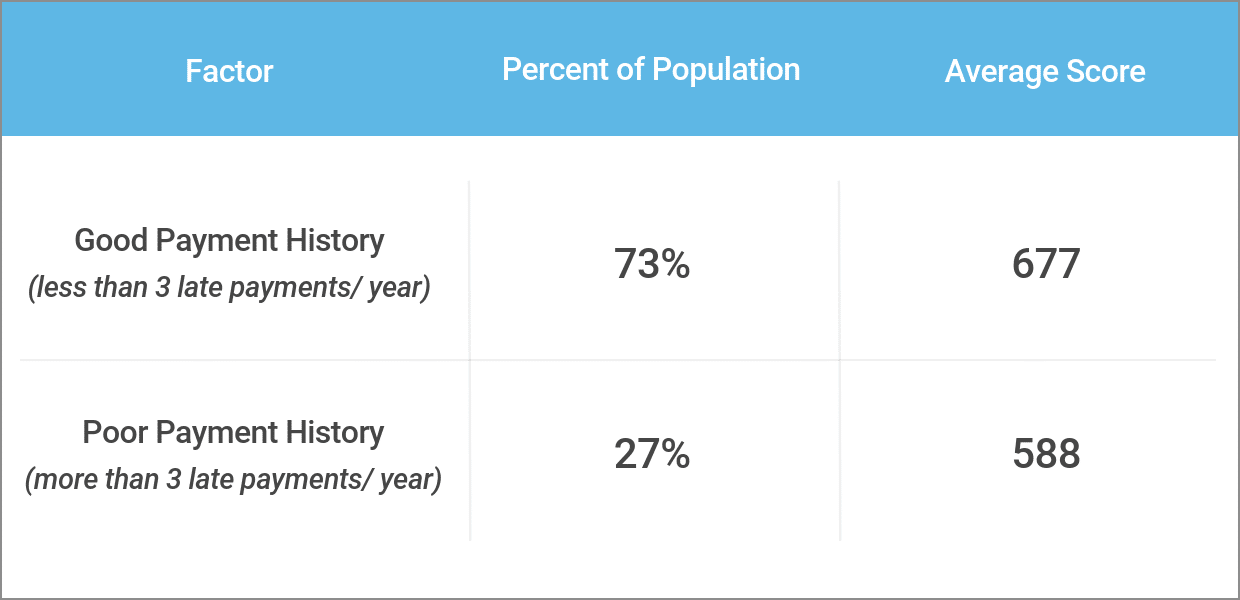
Photo Credit: Credit Sesame
1. Payment history
- Credit score weight: 35%
- % of population with room for improvement: 27%
- How to improve: Sign up for automatic payments to avoid missing due dates.
Payment history is a measure of whether or not you pay your bills on time, and it is the single most important factor affecting your credit score. Approximately 27% of people in the U.S. between age 18 and 49 miss three or more payments each year, causing their scores to suffer. Every monthly payment you make on time towards any of your accounts helps your credit score, but a single missed payment can damage it. Luckily, most missed payments that are remedied within 30 days aren’t reported to the credit bureaus. Additionally, how impactful a missed payment is on your score can depend on how long the bill goes unpaid past 30 days. Bills 30-days overdue might not be as damaging as those that are 60- or 90-days late. So if you miss a payment, make sure to get it in as quickly as you can.
If you’ve struggled in the past to make payments on time, consider signing up for automatic payments on your accounts and/or changing payment due dates to better align with your paycheck and other expenses.
2. Credit utilization
- Credit score weight: 30%
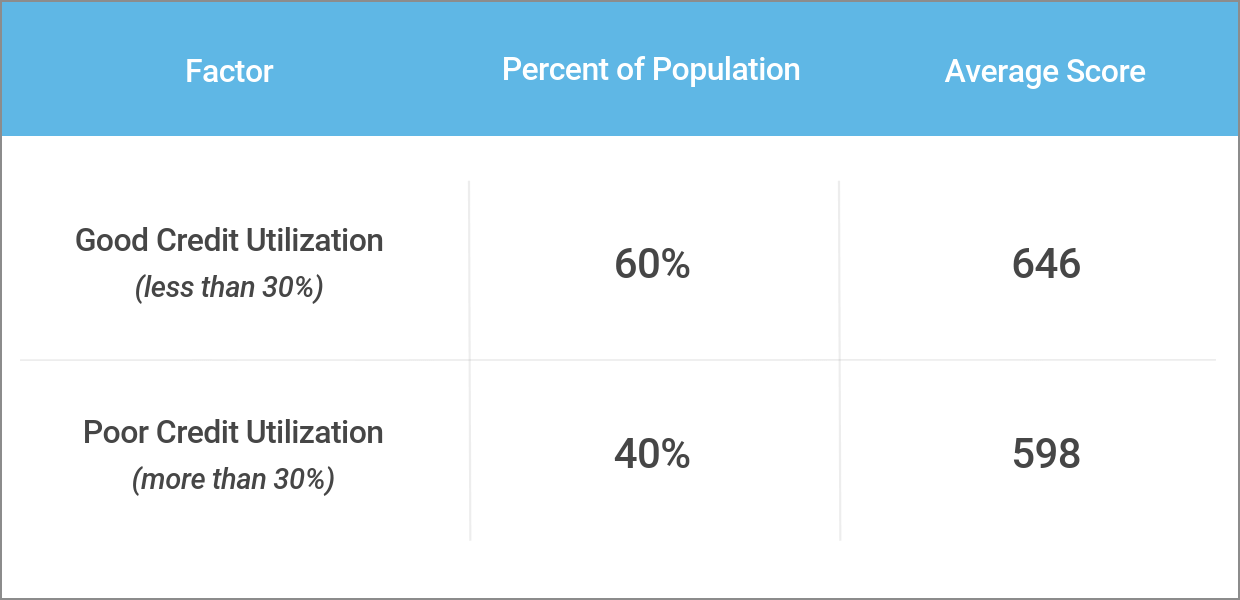
- % of population with room for improvement: 40%
- How to improve: Request a credit limit increase on your existing accounts or make early payments throughout your billing cycle.
At a weight of 30%, credit utilization counts almost as much as payment history towards your ultimate credit score. Credit utilization is simply a ratio of debt to available credit—in other words, how close you are to your credit limit on your revolving credit accounts (e.g. credit cards and lines of credit). With credit utilization, lower is better. For example, if you have an $8,000 combined credit limit across multiple credit cards and you have accumulated $6,000 in total debt across those cards, your utilization ratio would be 75%, which is high. It’s estimated that 40% of Americans are utilizing more than the recommended amount of credit, which is 30%. People with the best credit scores—over 800—use no more than just 7% of their available credit.
It’s important to note that even if you pay off your bill in full every month, your credit score can still suffer from high credit utilization. The most obvious way to decrease your utilization ratio is to simply spend less; however, if that’s not an option, another easy way is to request a credit limit increase on your existing accounts. Additionally, making early payments throughout your billing cycle is an option if you are unable to reduce spending or increase your limit.
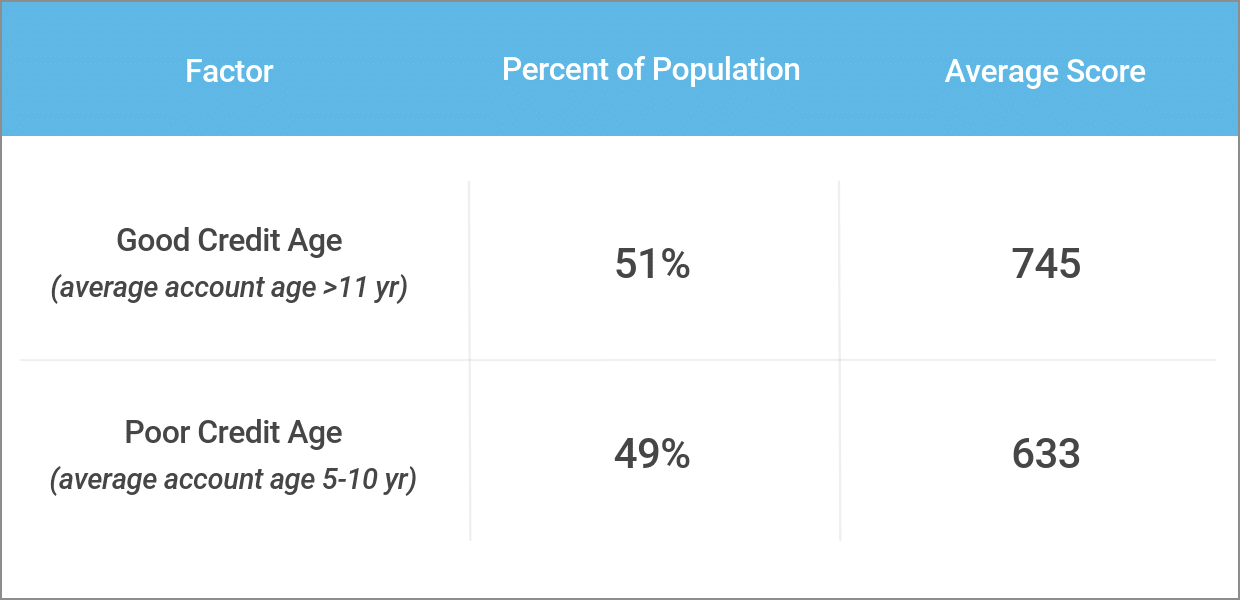
Photo Credit: Credit Sesame
3. Credit age
- Credit score weight: 15%
- % of population with room for improvement: 49%
- How to improve: Leave your old accounts open.
The third most important factor affecting your credit score is the average age of your credit accounts. Lenders assign more points to consumers who have a history of managing their accounts responsibly over long periods of time. Americans with an average account age that’s greater than 11 have an average credit score that’s 112 points higher (745 vs. 633) than those with an average account age between 5 and 10. So what’s the takeaway? Experian recommends leaving old accounts open to demonstrate your ability to manage credit over time. Leaving old accounts open also has the added benefit of lowering your utilization ratio if spending is kept constant. It’s estimated that 49% of U.S. consumers would improve their credit scores by leaving old accounts open.
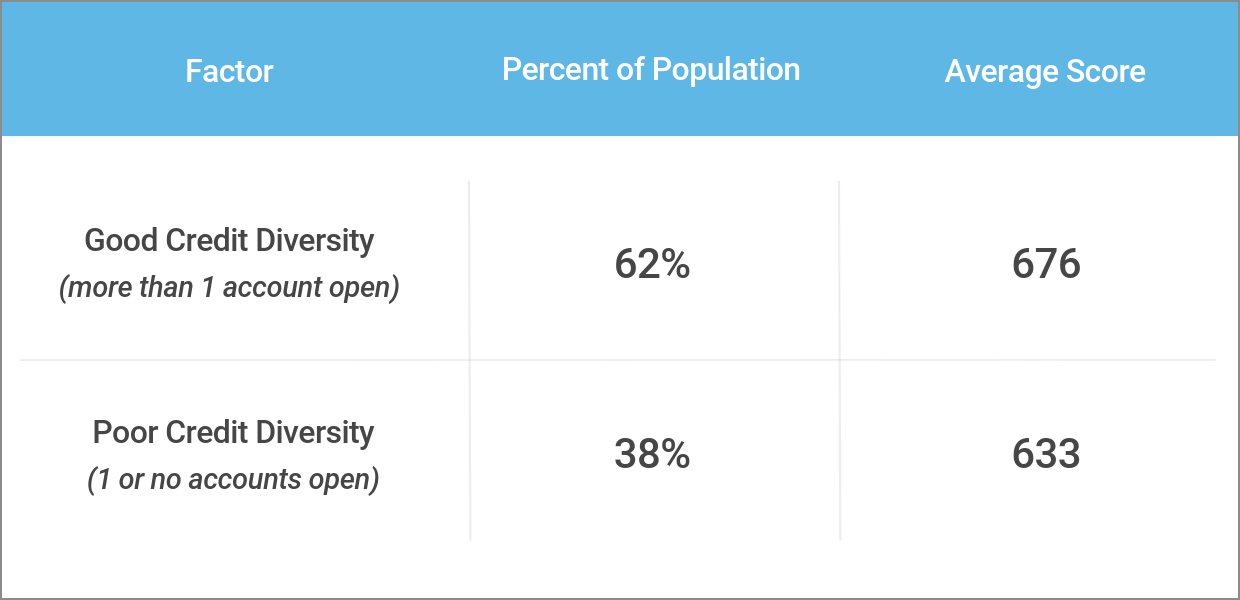
Photo Credit: Credit Sesame
4. Credit diversity
- Credit score weight: 10%
- % of population room for improvement: 38%
- How to improve: Make use of revolving credit and installment loans.
Credit agencies prefer consumers with a diverse credit mix, which demonstrates an ability to manage multiple types of credit accounts effectively. Someone scoring high for this factor would have a variety of open accounts, including both installment loans and revolving credit. Installment loans—like mortgages, auto loans, and student loans—are usually for a certain amount of money, have a fixed monthly payment, and a predetermined repayment schedule. Revolving credit accounts—like credit cards and home equity lines of credit—on the other hand, generally have a set credit limit that you can borrow from on a recurring basis. Almost 40% of Americans have just a single credit account, which means that many can benefit from utilizing additional credit products. Since credit diversity is only responsible for 10% of your overall score, taking out a large loan and paying the subsequent interest just to improve your credit mix might not be worth it. On the other hand, if you’ve only ever had a student loan and use a debit card for everyday expenses, substituting the debit card for a credit card could help.
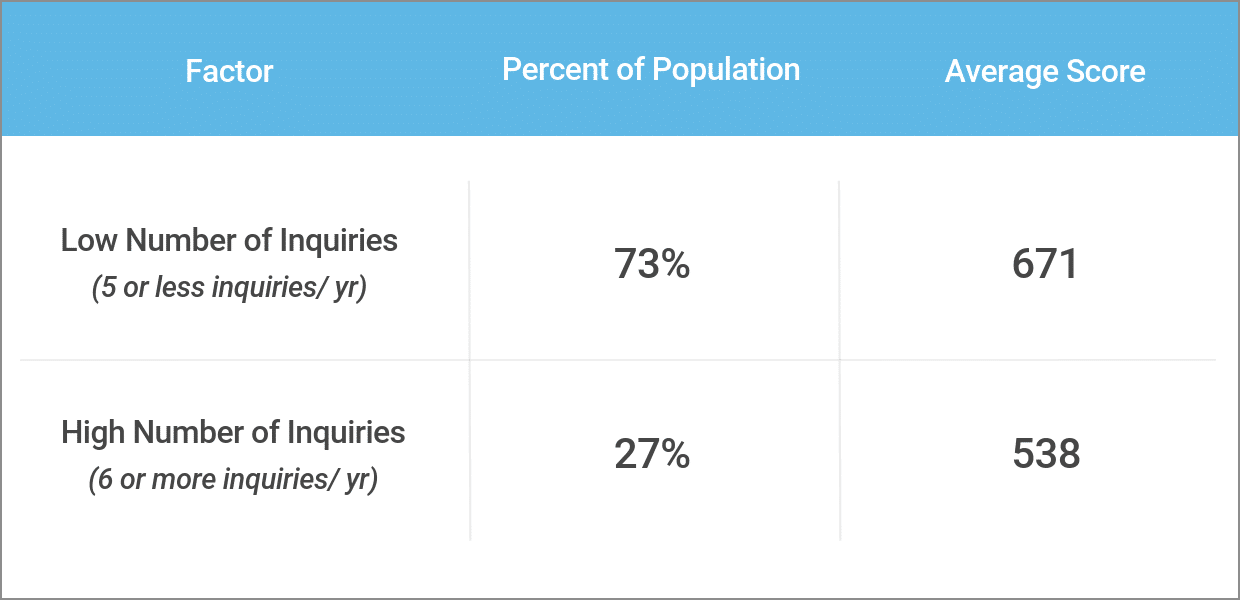
Photo Credit: Credit Sesame
5. Number of credit inquiries
- Credit score weight: 10%
- % of population with room for improvement: 27%
- How to improve: Avoid regularly opening new credit accounts and avoid opening a large number of accounts over a short period of time.
Every time you apply for a new credit account, an inquiry is placed on your credit report. These are known as hard inquiries. While soft inquiries, such as employer checks, self-checks, and prequalifying checks for promotional offers, don’t hurt your score, each hard inquiry can cause your score to drop by a few points temporarily. As discussed before, it’s a good strategy to open new accounts as a way to improve credit utilization and credit diversity, but consistently making excessive requests for credit can ultimately hurt your score. About one in four Americans have what’s considered a high number of inquiries—more than five inquiries per year—and would benefit from fewer hard inquiries on their reports.
Methodology
The data in this report is based on a series of surveys conducted by Credit Sesame in May of 2018. Credit factor weights were sourced directly from the Fair Isaac Corporation.
June 29, 2018 • by Lacey Langford
Finding the words charged off on your credit report isn’t good news. It can be scary and confusing when you don’t understand what it means or how it happened.
The name itself isn’t helpful either. People often misinterpret the meaning, which can lead to more costly mistakes with your credit.
Learning what charged off means and the impact charged-off debt has on your credit report can help you make informed decisions to get your credit back on track. Here is what you need to know about the meaning of charged off.
What Is a Charge-Off?
Having a charged-off debt means you have not been paying the full minimum payment on money you borrowed for a significant amount of time. Because of the delinquent payments, your debt is re-categorized as “charged off” on the company’s profit-and-loss statements. That means your creditor has given up hope that you will pay them back.
The company considers the debt a loss, marks it charged off as bad debt as a profit-and-loss write off, and will either sell or transfer your delinquent debt to a collection agency or a debt buyer.
At that point, one debt may now appear twice on your credit report, compounding the confusion. One debt listing will be from the original company you borrowed money from. The second listing is from the debt collector the account was transferred or sold to. Both accounts will show up as active, which can make it frustrating to decipher.
Does Charged Off Mean Paid Off? Do I Still Owe the Debt?
Having your debt charged off does not mean your debt is paid off. Charged off is often used interchangeably with written off, sometimes leading people to believe the creditor has written off their balance and they no longer need to pay their debts. That is not the case. The company is writing off your debt as a loss for its own accounting purposes, but it still has the right to pursue collection of the past-due amount.
You are still legally obligated to pay back the money you borrowed unless you settle(or file for certain types of bankruptcy) or the statute of limitations has been reached.
When Will a Charge-Off Happen?
Creditors will first try to send letters to remind you of a past-due bill. If that fails, they move to a collections process. Re-categorization to “charged off” typically happens after your payment is 180 days past due, though installment loans (something along the lines of a mortgage, for example) can be charged off after 120 days of delinquency.
The six-month mark comes from a generally accepted accounting principle that determines 180 days to be the point after which receiving payment is highly unlikely.
It is important to note that debts can be charged off even if payments have been made, providing that all of the payments were below the account’s monthly minimum. Once the debt is charged off, the delinquency is reported to credit agencies.
How Does a Charge-Off Affect My Credit Report?
A charge-off will be bad news for your credit report. Because a charge-off comes from missing payments, you will have late payments and a charge-off listed on your credit report. Negative information such as those lead to a lower credit score.
In fact, late and delinquent payments have the largest impact on your credit score: up to 35% of your score is determined by your payment history. And a lower credit score can cause everything from higher insurance rates to larger utility deposits to being denied credit.
How Long Does Charged-Off Debt Stay on My Credit Report?
Just like late payments, a charged-off account will remain on your credit report seven years from the date of the last scheduled payment before the account went delinquent. The time period does not start over again if the debt is sold to a collection agency or debt buyer. After the seven years, the charged-off account will automatically be removed from your credit report.
How to Remove a Charge Off from a Credit Report
To remove a charge off from your credit report, you will first have to contact the original creditor to begin negotiations. You will have to convince the creditor that you need the charge off removed, but in exchange, you will provide payment of the debt owed. If you have a larger chunk of money available that you can pay on the debt, then you may have a better chance of success at negotiating.
Before contacting the creditor, you should have a fairly good idea of how much you can realistically pay them on the account. It is also good to note that if the account is in collections, then there is nothing they can do to remove the charge off (although they can remove the collection account). You must speak directly to the original creditor about possibly removing the charge off.
You can also speak to the original creditor about a payment arrangement, however, make sure you do not provide them with any excuses or reasons as to why you weren’t paying before. All they want to know is if you are able to pay the debt you owe. Remain both polite and professional while speaking to the creditor in charge of your charged off account.
What Should I Do if I Have a Charge-Off?
The best thing to do is to pay the balance of your charged-off debt in full and settle the debt. Once paid, the report will show “paid charged-off.” It won’t remove the charge-off from your credit report, but it will show you are making an effort to resolve the negative account.
If you are unable to pay the debt in full, create a budget to find extra money to pay down the debt quicker. Paying your other debt on time each month is another great way to improve your credit report.
If you want to avoid having any of your accounts charged off, the best thing to do is take preventative measures. Learn and maintain positive financial habits and avoid living outside your means. Look into automating your finances as well to make sure you don’t miss any payments on your cards and put yourself at risk for getting charged off.
Bottom Line
When learning what a charge off is and what you must do to get past this negative mark on your credit report and settle your debt, you should take all the advice we have given you and heed the suggestions while remembering the key points of a charge off:
- You are still responsible for paying off the debt even if the account has been charged off. This means the full amount owed to the original creditor, and they are able to attempt to collect the debt until the statute of limitations runs out.
- You might end up making your payments to a third-party collection agency, or debt collector, rather than the original creditor determinant on how much time has passed. If this is the case, however, be sure to practice extreme caution because there are many scams going around in regard to collection agencies.
- Your credit will definitely suffer through the entire process because of your bad debt. A charged off account is a big, bold mark on your credit report and it will remain so even after the debt has been paid in full. However, it will look much better if your credit report says that you have paid the account or settled next to the charge off, instead of the charge off sitting as is, unpaid, with no positive notations.
Finally, remember, if you are in debt and feel like you have nowhere to go, there are plenty of debt management programs you can become a part of and they will help educate you on what you need to do to begin rebuilding your credit and digging yourself out of debt.
It is always better to do everything you can to avoid a charged off account appearing on your credit report in the first place. To do this, be sure that you are paying on all your accounts as agreed upon between yourself and the creditors, never allow your payments to become late or overdue, and help recover your credit score by paying off your credit account balances so everything is in good standing.
And don’t forget to check your credit reports from the major credit bureaus at least once a year to make sure everything is accurate and being paid. If you want to check your progress more often, you can get a free credit report summary, updated monthly, from Credit.com.
Be sure you are checking credit reports from all three of the major credit bureaus because the information contained in each may differ.
If you’re concerned about your credit, you can check your three credit reports for free once a year.
How Much Will One Late Payment Hurt Your Credit Scores?
July 13, 2018 • 8 min read by Gerri Detweile from Credit.com
You open your statement and discover you’re late on your credit card payment. Or you get a call from a collection agency about a medical bill you forgot to pay. Or you check your credit reports and discover a late payment is marring your otherwise perfect payment history.
What happens if you miss a credit card payment? How do late payments affect your credit scores? Of course, as with so many things related to credit scores, the answer is, “It depends.”
Hope for the Best
Late payments and good credit scores go together like toothpaste and orange juice—they don’t mix. But just how bad is it to miss a single payment?
First, it depends on how many days late your payment is. If you missed your credit card payment by one day, you probably don’t need to sweat it.
If you’re lucky, the lender won’t report the lapse. “Most lenders do not report missed payments until the account is 30-plus days past due,” says Anthony Sprauve, PR director for MyFico.com.
“Suppose a given credit card payment is due on May 15 [and you pay on] May 25. Technically, the payment is late, and fees and interest charges may apply. But in most cases, this late payment would not be reported by the creditor to the credit reporting agencies [CRAs].”
Or perhaps your lender may overlook the transgression. Steve Ely, president of eCredable.com, adds, “The larger creditors [like credit card companies] usually have sophisticated analytic models working behind the scenes that take into account your history of payments. If you’ve been paying on time for a long time, they’re likely to forgive your one late payment and let it slide.”
But Brace for the Worst
What if you don’t luck out and the creditor reports the late payment? Here are three questions that will help you understand the possible impact, according to Barry Paperno, community director for Credit.com:
- How long ago did the most recent late payment occur?
- How severe were the late payments (30 days, 60 days, charged off, etc.)?
- How many accounts on the credit report have had late payments?
“Of these three questions, the one typically having the most impact on your credit score is the first: recency,” says Paperno. “To illustrate, if a single late credit payment occurred a few years ago and all payments on all accounts have been made on time since, that single late payment will have little negative impact on your score.”
How Bad Can It Get?
To put the potential consequences in perspective, Paperno points to a study about credit scoring effects conducted by FICO that points to a scary possibility. “[A] recent late payment can cause as much as a 90- to 110-point drop on a FICO score of 780 or higher.”
Although score drops from late payments tend to rise again over time, these credit dings can remain on your credit report for seven years, according to Paperno. You can expect the effects to last for much of that time.
Sprauve also explains that the impact of a missed credit card payment or late bill on your FICO credit score varies significantly depending upon the individual consumer’s circumstances. He details some of the factors that can help determine how much a late payment will hurt your scores:
- Any history of account delinquencies or collection references (on any account)
- Any adverse legal items on your credit report
- The outstanding balance on the delinquent account
- The number of other accounts on the file that you’ve currently paid as agreed
- The length of your credit history
The Bigger They Are, the Harder They Fall
The irony is, the better your credit, the more you may feel the sting. One slipup and your credit score may take a dive—even if you have otherwise stellar credit.
“The old [adage] of ‘the bigger they are, the harder they fall’ applies to credit scores too,” warns Ely. “If you have a really high FICO Score, you’ll take a bigger hit for a late payment than someone with a lower FICO Score.”
The best defense is to be meticulous about paying your bills by the due date. But if you do mess up, see if you can’t convince the lender or collector to remove the ding from your reports. While they may balk at first, you may be able to persuade them to change their mind if you have a good explanation—and they believe you when say it won’t happen again.
What You Can Do
If you’re concerned about how late payments could be damaging your credit, you can check your three credit reports for free once a year from each of the reporting agencies. To track your credit more regularly, Credit.com’s free Credit Report Card is an easy-to-understand breakdown of your credit report information that uses letter grades—plus you get two free credit scores updated each month.
Tips to Make Sure You Don’t Miss Payments
If you want to find ways to help avoid making late payments or missing them altogether, here are a few tips and tricks to keep in mind:
Sign up for Auto Pay
Auto pay can be extremely beneficial for those that find themselves forgetting to make their bill payments on time. Auto pay is simply when you authorize the credit issuer or lenders to automatically deduct your monthly payment amount directly from your checking account on the due date.
Even with auto pay, it is still recommended that you pay more than just the minimum amount that is due on your credit accounts, so you can avoid pay higher interest rates because of the balances you may carry from month to month. Doing so will also positively affect your credit standing.
A downfall to auto pay, however, is that you have to be sure that you have the funds available in your account prior to the date the funds are to be withdrawn. If you don’t have enough to cover the payment, then you may experience fees in addition to the missed monthly payment.
Set Up Reminders
Another way you can effectively pay your bills on time to help you credit history and credit scores is to set up payment reminders instead of relying on your memory.
Calendar and online reminders on a phone or other mobile device are probably the most popular ways to keep track of what you have to pay and when it needs to be paid. You can also ask the creditor to provide you with online alerts when your payments are coming due.
Weekly Payments
While most account payments are due once per month, it may be in your best interest to instead pay weekly on the account. By doing so, you may find that it is easier to control your overall balances and it will help you pay everything off a bit faster.
However, if you cannot afford to make payments weekly, then you should instead consider one of the other options we have already mentioned.

Looking for more? Check out:
Ouch! Overspending leads to stories like this and to collections! Be smart with our $$$!
In one of the few efforts to expand the Telephone Consumer Protection Act (TCPA), Democratic lawmakers introduced new legislation that includes changes to the revocation of consent, the definition of an automatic telephone dialing system (ATDS) and more.
Sen. Ed Markey (D-Mass.) and Rep. Frank Pallone (D-N.J.) sponsored the Stopping Bad Robocalls Act in companion bills in both houses of Congress in reaction to the U.S. Court of Appeals, D.C. Circuit’s recent decision in ACA International v. FCC. There, the federal appellate panel struck down the Federal Communications Commission’s (FCC) overly expansive definition of an ATDS found in its 2015 ruling.
The proposed legislation would remove the term “ATDS” from the TCPA and replace it with “robocall,” defined as “[a] call made (including a text message sent) … using equipment that makes a series of calls to stored telephone numbers, including numbers stored on a list, or to telephone numbers produced using a random or sequential number generator, except for a call made using only equipment that the caller demonstrates requires substantial additional human intervention to dial or place a call after a human initiates the series of calls; or … using an artificial or prerecorded voice.”
Although it does away with the oft-contested issue of “capacity” found in the ATDS definition, the proposed legislation incorporates text messages as well as additional types of equipment (predictive dialers, for example), broadening the scope of coverage. It also shifts the burden of proving human intervention to TCPA defendants.
Addressing consent, H.R. 6026 would establish that express consent may be revoked “at any time and in any reasonable manner, regardless of the context in which consent was provided.” Callers that violate the prohibitions on autodialed calls, robocalls or spoofing would face additional liability pursuant to the measure, which extends the statute of limitations to four years. This section of the bill would also eliminate the requirement that the FCC wait for a second offense, permitting the agency to immediately go after bad actors.
The legislation would keep the FCC busy, providing it with several tasks. One provision would mandate that the FCC create a nationwide database of consumer telephone numbers that have been reassigned to other consumers and establish a safe harbor for TCPA defendants in the event an error exists in the database.
In addition, the FCC would be tasked with making an annual report to Congress. After consultation with the Federal Trade Commission, the FCC would be required to share its progress in stopping robocalls and provide recommendations for how to reduce such calls by at least 50 percent year-over-year.
The measure also granted the FCC one year after enactment to prescribe consumer protections to require telephone service providers to authenticate the source of calls. After that time, calls that have not been authenticated should not be completed unless subscribers have chosen to unblock such calls. Providers would not be permitted to charge subscribers for this service.
“There is nothing more annoying than repeatedly getting unwanted calls from people you don’t know and don’t want to talk to,” Rep. Pallone said in a statement about the legislation. “Despite previous efforts like the Do Not Call Registry, robocalls are on the rise. The Stopping Bad Robocalls Act will better restrict unauthorized robocalls by providing consumer protection agencies with new tools designed to stop the abusive practices robocallers are employing.”
To read H.R. 6026, click here.
Why it matters: Referred to committee, the legislation would make a host of plaintiff-friendly changes to the TCPA, from broadening the scope of an ATDS to increasing the statute of limitations for certain violations of the statute to a generous standard for the revocation of consent.

Diversified Adjustment Service Inc. Named 2018 Top Workplace
ACA International member recognized for culture and employee engagement.
Diversified Adjustment Service Inc., an ACA International member company in Coon Rapids, Minn. and importantly, as a certified Woman Business Enterprise, is among the top workplaces in the state recognized by The Star Tribune newspaper .
“The culture within Diversified Adjustment is contagious. That employee driven-attitude encourages teamwork, respect, friendship and laughter,” said Diversified Adjustment Service Inc.’s President and COO Rob Zurek. “Coming to work is always a positive experience that our people enjoy and embrace.”
Star Tribune Top Workplaces recognizes the most progressive companies in Minnesota based on employee opinions measuring engagement, organizational health and satisfaction, according to a news release. The analysis included responses from over 71,000 employees at Minnesota public, private and nonprofit organizations.
“The companies in the Star Tribune Top Workplaces deserve high praise for creating the very best work environments in the state of Minnesota,” Star Tribune Publisher Michael J. Klingensmith said in the news release.
Follow ACA International on Twitter @ACAIntl and @acacollector, Facebook and request to join our LinkedIn group for news and event updates. ACA International members are welcome to submit news items for possible publication to comm@acainternational.org.
Visit our publications page for news submission guidelines and subscriptions to ACA Daily, Collector magazine and Pulse. Advertising is available for companies wishing to promote their products or services. Be sure to visit the ACA Events Calendar on the Education and Training website to view our listing of upcoming CORE Curriculum and Hot Topic seminars featuring critical educational opportunities for your company.
Full ACA article Here! Diversified-adjustment-service-in-named-2018-top-workplace
Related:
Diversified Adjustment Service wins Star Tribune Top Workplace award